|
NEXTSTEP RELEASE 3
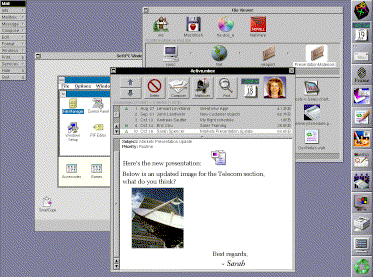
NEXTSTEP provides the premier platform for the development and deployment of object-oriented mission critical custom applications.
NeXT is the only company to provide a completely integrated object-oriented client/server computing environment for enterprise-wide software development and deployment. Its environment, NEXTSTEP is the premier system for developing and deploying custom client/server business applications and integrating them with advanced productivity software throughout a heterogeneous network. NEXTSTEP provides cross-platform integration, superior ease of use, and the robustness needed for handling mission-critical applications globally.
Fully object-oriented operating environments appeal strongly to programmers, systems administrators, and users. For systems administrators, objects reduce maintenance time and costs. At the system level, objects enable programmers to rapidly reuse and customize core business components. At the application level, users will find feature and interface consistency across applications.
NEXTSTEP is based on the industry-standard Berkeley UNIX operating system and the Mach system kernel. NEXTSTEP integrates seamlessly with the most popular local and wide area networks including NFS and Novell and also accesses Macintosh and MS-DOS filesystems. Users with no training in networks or file systems can easily navigate networks and share information using Workspace Manager a powerful and easy-to-use file management application.
NEXTSTEP includes the class libraries needed to use custom software developed with NeXT's NEXTSTEP Developer product. When it's coupled with the Enterprise Objects Framework, users can benefit from object persistence in relational database applications.
NEXTSTEP also bundles powerful user and system management applications. These include NeXTmail a multimedia electronic mail system; FaxReader for viewing faxes; Digital Librarian a powerful full-text searching tool; Edit, a multifont text editor; and NetInfo a tool for administering network resources.
PRESENTING NEXTSTEP |
The NEXTSTEP User Experience
NEXTSTEP provides the power of objects in an award-winning graphical user interface with the underlying robustness of the UNIX client/server operating system.
Enterprise Solution
Objects have paved the way for quicker application development. However, deploying a custom application across an enterprise is no small task. NEXTSTEP continues to lower the cost of computing by reducing the number of cycles spent in deployment, training, and maintenance. An added benefit of NEXTSTEP is an increase in overall productivity. All of this is possible because NEXTSTEP is extremely scalable - even when the quantity of deployed machines numbers into the tens-of-thousands.
Rapid Deployment and Less Maintenance
NEXTSTEP can be installed and fully integrated into a network in less than one hour, which is significantly less time than any other environment. The operating system can be loaded from a CD or from an installation server across a network. Through NetInfo, every NEXTSTEP machine learns about all of the services the network has to offer. This includes file servers, printers, fax modems, and user accounts as well as important network parameters. In addition, NEXTSTEP-based computers can interoperate seamlessly with other systems in the existing network environment.
A network user's needs do not stop once the system has been deployed. Adding new network resources for global access is often quite complicated for network administrators to perform in other environments. NetInfo allows administrators to easily keep track of all network resources across the enterprise. The entire NEXTSTEP network can be maintained remotely from any machine, and future software distribution can also be handled remotely. Performing any of these tasks helps significantly reduce the cost of deploying and maintaining custom or mission-critical applications.
Cross-Platform Integration
The NEXTSTEP environment supports multi-architecture binaries. This allows one application binary to be launched on all NEXTSTEP architectures. Therefore, systems administrators no longer need to maintain separate versions for every platform architecture in the organization. Third-party software vendors also release products for several platforms in one binary file. Applications can run side-by-side with X/MOTIF applications via third-party emulation. On Intel PCs, users can even run legacy DOS/Windows applications in the NEXTSTEP environment. All of these applications can access remote client/server databases, support enterprise-wide collaboration, and add value to information contained in legacy mainframe systems. Desktop integration is a real benefit of NEXTSTEP.
Application Productivity
NEXTSTEP allows applications and information to integrate effortlessly and seamlessly. Thanks to Object Links, information in one NEXTSTEP application can be embedded and linked into another application. Using Services, applications can extend their own functionality by borrowing the features of other applications - giving every application such capabilities as optical character recognition, database searching, scanning, information filing, or mail services, all without leaving the application currently in use. With NEXTSTEP, users can work with the information they need and the applications they prefer, confident that the applications will integrate with unparalleled flexibility. In addition, users can integrate the many advanced productivity applications available under NEXTSTEP
with their own custom applications.
Collaboration
Using NEXTSTEP, users are ready to collaborate. NEXTSTEP makes navigating large or small networks a breeze. NEXTSTEP's graphical Workspace Manager allows users to use network files and information resources as easily as they manage their own personal files - whether they are on an NFS server or a NetWare network. NEXTSTEP's multimedia electronic mail system makes sharing information of any kind as easy as drag and drop.
Ease of Use = Less Training
NEXTSTEP's ease of use comes from its object-oriented core. By providing the fundamental object building blocks used by all applications, NEXTSTEP ensures user interface consistency. The NEXTSTEP environment provides tear-off menus anywhere on the screen, performs file manipulation by drag and drop, and browses local or wide area networks easily. Users can create "bookmarks" to return instantly to any server, directory, or file anywhere on the network, place the most used applications on a convenient dock, and view files in list file hierarchy or icon format. All applications maintain a similar user-interface using system level objects such as font panels, color panels, and print panels. This allows users to get up to speed with new applications quickly.
Information-Rich and Media-Rich Computing
NEXTSTEP is designed to be an information-rich and media-rich environment. NEXTSTEP uses Display PostScript, so what is seen on screen is exactly what is printed, in black and white or color. NEXTSTEP also allows users to add sound to any application. Using NEXTSTEP's Digital Librarian, users can create custom information resources such as guides, dictionaries, and reference tools, which can contain graphics and which are accessible from within any application. And should users ever need help, NEXTSTEP's integrated Help facility is only a mouse click away.
NEXTSTEP FEATURES AND BENEFITS

Workspace Manager
A graphical environment for managing network-wide documents and applications on NEXTSTEP systems.
Provides a rich variety of tools to interact with the NEXTSTEP environment: the application dock to manage frequently used applications; the Processes panel to manage application and background processes; and Inspectors to manipulate file attributes and security. The File Viewer allows you to navigate the network with listing, browser, and iconic views, to open files in their associated applications, and to place frequently used files on a convenient shelf.

NeXTmail
A sophisticated electronic mail system for exchanging multi-media messages containing files, formatted text, images, and sound objects. MIME support provides interoperability with e-mail applications on other platforms.
Dramatically enhances communication among workgroup members. Multimedia NeXTmail allows the exchange of multi-font messages with images, voice annotations, and any type of application or data file. Files or selected items can be sent from within an application, or simply drag-and-drop documents anywhere within a message. NeXTmail is fully integrated into the NEXTSTEP operating environment.


PC and Macintosh Connectivity
Macintosh and MS-DOS file system compatibility. Integrates industry standard networking capabilities, including TCP/IP, NFS, and Novell NetWare.
NEXTSTEP contains industry standard networking to accommodate its integration into existing environments, as well as to meet your requirements for network size and scalability. Provides connectivity in heterogeneous environments. Novell client access to files and printers on NetWare networks. Preserves current investment in networks of PCs while you take advantage of the advanced features of NEXTSTEP-based systems.

NetInfo
A platform independent tool to effectively manage heterogeneous networks.
NetInfo reduces installation and maintenance costs by reducing the number of people required to manage a network.NetInfo is platform independent, easy to use, and will scale throughout the enterprise. Its hierarchical and distributed design allows systems administrators to tailor the system to individual needs.

On-Line Help
Context-sensitive with hypertext linking and graphics. A standard panel across all applications.
Offers quick assistance on applications' features and use. Demonstrates how to use an application in real time, without stopping for training.

Global System Software
NEXTSTEP user interface is available in English, French, German, Spanish, Swedish, and Italian.
Everything can be in users' native language. Allows users to change environment to other languages easily.
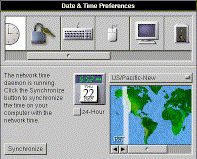
Customizable User Environment
Preferences for security, system interface appearance, and language preferences.
Allows tailoring of computing environments to fit personal style and needs. These preferences will follow suit on many machines on the NEXTSTEP network.

IntelPlatform DOS/Windows Interoperability
Supports multiple partitions on the local PC hard drive, enabling operating systems such as DOS to reside on the same disk as NEXTSTEP. Using third party products, users can run DOS and Windows applications within NEXTSTEP for Intel Processors.
Preserves investment in PC hardware, and in DOS and Windows applications and data. Provides complete integration within the workgroup.

NEXTSTEP Interoperability
Multi-architecture binaries allow developers to create a single executable that runs on four hardware architectures. (Intel, Motorola, SPARC, and PA-RISC)
One application binary can be launched on all NEXTSTEP systems, regardless of the processor. Allows choice for the best hardware solution to meet needs while providing complete integration within the workgroup.
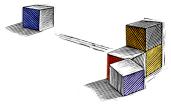
Object Integration
Object persistence and distribution models are easily integrated into the user environment.
Distributed Objects enables object messaging across NEXTSTEP clients, providing an easy framework for building powerful client/server applications. Optional PDO seamlessly extends NEXTSTEP's industry-leading object model to non-NEXTSTEP operating systems. The optional Enterprise Objects Framework seamlessly extends the power of NEXTSTEP's object-oriented paradigm to client/server database applications.


Object Links
A way to share information among documents so that changes made in one are automatically reflected in the others.
Makes it easy for workgroups to produce collaborative documents by streamlining the revision process.Assures users that shared information is up-to-date. Allows for a single document that is a composite of information from different applications, and is updated automatically.

Deployment Tools
BuildDisk, Configure, NetInfoManager, NetInstallHelper, NFSManager, SimpleNetworkStarter
NEXTSTEP can be installed and fully integrated into a network in less than one hour. The entire NEXTSTEP network can be maintained remotely from any machine. Network administration tools are GUI-based for easy maintenance.

Digital Librarian
A full text indexing and searching tool for creating custom digital libraries of many forms of electronic information.
Allows access to important information via single or multiple-keyword searches. Provides instant full text search access to system and application documentation, or any other text file.

Display PostScript Level II
Uses the device-independent PostScript imaging model. Includes full color support and PostScript Level I compatibility.
Ensures what is on the screen is what is printed on color and black and white PostScript printers (to the best of physical capabilities and PostScript levels). Includes complete screen support for scalable PostScript fonts.
SYSTEM REQUIREMENTS
NEXTSTEP is designed to run on a wide variety of hardware platforms. For specific supported configurations, please refer to the NEXTSTEP Hardware Compatibility Guide. For any hardware specification or purchase, please contact NeXT for the latest update to this guide.
FOR MORE INFORMATION, CALL 1-800-TRY-NEXT
(c)1988 - 1995 NeXT Computer, Inc. All rights reserved. NeXT, the NeXT logo, NEXTSTEP, the NEXTSTEP logo, Enterprise Objects, Portable Distributed Objects, PDO, Application Kit, Database Kit, Digital Librarian, Digital Webster, Indexing Kit, Interface Builder, NeXTmail, NetInfo, Project Builder, Sound Kit, 3D Graphics Kit, and Workspace Manager are trademarks of NeXT Computer, Inc. TEX is a trademark of the American Mathematical Society. PostScript and Display PostScript are registered trademarks of Adobe Systems Incorporated. VT100 is a trademark of Digital Equipment Corporation. Webster's Ninth New Collegiate Dictionary and Collegiate are registered trademarks of Merriam-Webster, Inc. and are used herein pursuant to license. Novell and NetWare are registered trademarks of Novell, Inc. RenderMan is a registered trademark, Interactive Renderman and Photorealistic RenderMan are trademarks, of Pixar. ORACLE and SQL*Net are registered trademarks of Oracle Corporation. SPARC is a trademark, and NFS is a registered trademark, of Sun Microsystems, Inc. SYBASE is a registered trademark, and DB-Library is a trademark, of Sybase, Inc. UNIX is registered trademark in the United States and other countries, licensed exclusively through X/Open Company Limited. All other trademarks mentioned belong to their respective owners. NeXT will from time to time revise the specifications described herein, and reserves the right to make such changes without obligation to notify the purchaser.