ENTERPRISE OBJECTS FRAMEWORKTM
RELEASE 1.1
Enterprise Objects Framework seamlessly extends the power of NEXTSTEP's
object-oriented paradigm to the development of client-server database applications.
The Enterprise Objects(tm) Framework builds on NeXT's leadership in object-oriented software development tools by dramatically reducing the costs of building and maintaining database applications. The Framework is unique in its ability to bring the benefits of object-oriented programming to relational database application development. The Enterprise Objects Framework enables developers to construct reusable business objects that combine business logic with persistent storage in industry-standard relational databases. Developers create business objects once and reuse those objects to manage enterprise-wide operations.
Applications developed with the Enterprise Objects Framework support a three-tier client/server architecture by maintaining a clear separation between the user interface, business objects, and the database. Business objects are completely insulated from the underlying data structures used for data storage. Any changes to the database schema are easily accommodated without recoding. The same business object can be reused even when data is stored differently throughout the organization. The Enterprise Objects Framework also allows business objects to be developed independently of an actual data source. This architecture allows the migration of individual objects or entire applications to new data sources, including relational databases, hierarchical databases, and on-line news feeds, without recoding.
Portable Distributed Objects(tm)-PDO(tm)-extends NEXTSTEP's industry leading object model across heterogeneous operating systems. With PDO, developers have an infinitely flexible choice of object deployment strategies. Business objects can be deployed on NEXTSTEP clients and a variety of server class machines running HP-UX, SunOS, Solaris, and Digital UNIX operating systems. The pairing of PDO with the Enterprise Objects Framework creates a distributed computing environment that enables applications to scale by leveraging all computing resources across the enterprise.
FEATURES AND BENEFITS
Bridges the gap between objects and relational databases
The Enterprise Objects Framework provides the infrastructure for defining both the object model for the business and the entity-relationship model for data. Using these two models, developers can build custom objects that encapsulate both data and business processes, while the Framework itself provides the data access services that make these objects persist in a relational database.
Business-centric development approach
Using the Enterprise Objects Framework, developers build business-centric information systems from custom objects that tightly integrate business information and business processing. The resulting business model enables analysts, users, and managers to communicate and understand the most important aspects of the operation because business entities are represented in a form that naturally combines information and process.
Three-tiered client/server application architecture
Applications developed using the Enterprise Objects Framework maintain a clear separation between the user interface, business objects, and the database schema. Business objects can easily be reused within applications and across application boundaries, even if the user interface or the database schema is different. Organizations can develop libraries of component objects and assemble a collection of these objects into an application on an as-needed basis.
Application partitioning
Combined with NeXT's Portable Distributed Objects technology, business objects can take advantage of computing resources available anywhere on the network, providing tremendous scalability of applications for the enterprise. Enterprise Objects Framework applications can be developed without concern for where objects will be deployed. Objects can then be located on the most appropriate client, compute server, or database server, making the most effective use of processing resources. Client applications message all objects identically, whether they are local or distributed. As business needs change, the location of objects can change without any impact to existing applications. Business objects can be deployed on NEXTSTEP clients and HP-UX, SunOS, Solaris, and Digital UNIX servers.
Database schema independence
Business objects developed with the Enterprise Objects Framework are insulated from the underlying data structures. Changes to the database schema can be easily accommodated simply by having an alternate mapping from the properties of enterprise object classes to alternate attributes of the database schema. This independence allows business objects to be reused enterprise-wide, even when data is represented differently throughout the organization.
Database-independent implementation
The Enterprise Objects Framework's layered architecture effectively insulates application logic from the semantics of how data is actually stored and retrieved. Applications can be migrated to different databases without recoding any business logic. A single application can also integrate data from multiple data sources. The data sources may be relational databases from a single vendor or from multiple vendors, and may even include hierarchical databases, on-line news feeds, and other data sources.
Integrated development environment
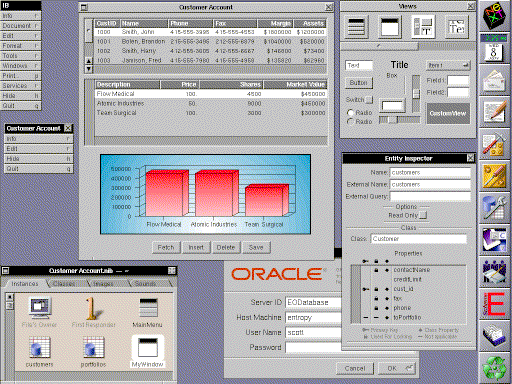
The Enterprise Objects Framework works seamlessly with NEXTSTEP's Project Builder(tm), Interface Builder(tm), and Application Kit(tm). Developers need only write application code that adds strategic value for their businesses to gain a competitive advantage. Enterprise Objects Framework applications can easily incorporate all features of NEXTSTEP, including interprocess communication, support for graphics and sound within an application, and cut/copy/paste functionality between applications. Application developers can also take advantage of the new Foundation classes to begin developing OpenStep(tm) applications today.
Enterprise Object Modeler application
With the Enterprise Object Modeler, developers simply define associations between properties of business objects and attributes of the database schema to persistently store business objects in a relational database. The Enterprise Object Modeler also provides utilities to reverse-engineer an existing database schema and create default object and database models, allowing developers to quickly build new applications.
Open architecture
The Enterprise Objects Framework business model provides a public API that allows developers to use their preferred design and analysis tools and to integrate design information from existing repositories. The non-proprietary format of the business model allows developers to add extensions to the model. The business model can be referenced or dynamically modified by the application at runtime.
Database adaptors
Database adaptors for ORACLE and SYBASE are bundled with the Enterprise Objects Framework. No other software is required for Enterprise Objects Framework applications to access these databases. Adaptors for many other databases are available from database vendors and third party developers.
PRODUCT DETAILS
Enterprise Objects Framework Release 1.1 includes both client and server software.
Enterprise Objects Framework Release 1.1 Client Product Components
Enterprise Object Modeler
Runtime Libraries
ORACLE and SYBASE Database Adaptors
System Requirements
Intel-based PC, NeXT Computer, SPARC or PA-RISC Workstation
NEXTSTEP Release 3.2 or greater NEXTSTEP Developer Release 3.2 or greater (for development)
Enterprise Objects Framework Release 1.1 Server Product Components
Runtime Libraries
ORACLE and SYBASE Database Adaptors
System Requirements
Workstation running HP-UX, SunOS, Solaris, Digital UNIX
PDO 3.0
For additional information call 1-800-TRY-NeXT
NeXT Computer, Inc., 900 Chesapeake Drive, Redwood City, CA 94063 U.S.A.
©1993-95 NeXT Computer, Inc. All rights reserved. NeXT, the NeXT logo, NEXTSTEP, OpenStep, Enterprise Objects, Application Kit, and Interface Builder are trademarks of NeXT Computer, Inc. UNIX is a registered trademark of UNIX Systems Laboratories. ORACLE is aregistered trademark of Oracle Corporation. SYBASE is a registered trademark of Sybase, Inc. All other trademarks mentioned belong to their respective owners. NeXT will from time to timerevise the specifications described herein, and reserves the right to make such changes without obligation to notify the purchaser.